At temperatures above 900°C, most piping materials begin to fail. Oxidation strips wall thickness, carburization makes metal brittle, and cyclic thermal stress opens cracks at weld seams. Engineers working with industrial furnaces know this pattern well, and most arrive at the same solution: Inconel 600 pipes. Performance at that level is not a matter of reputation; it is a matter of chemistry.
Understanding High-Temperature Furnace Operating Conditions
Industrial furnaces used in annealing, hardening, and petrochemical processing sustain internal temperatures between 870°C and 1150°C during normal operation. Three simultaneous threats act on every pipe like extreme radiant heat, chemically aggressive combustion gases, and repeated thermal cycling as furnaces start, run, and shut down.
Carbon steel loses meaningful strength above 425°C. Austenitic grades like 304 and 316 stainless steel begin scaling aggressively past 870°C, and carburizing atmospheres accelerate wall degradation further. These limitations push material selection toward nickel-based alloys built for thermal extremes.
What Are Inconel 600 Pipes?
Inconel 600 carries a nominal composition of 72% nickel, 14 to 17% chromium, and 6 to 10% iron. The nickel base resists reducing environments; the chromium fraction forms a self-repairing oxide layer that holds up in oxidizing atmospheres at temperatures far beyond what iron-based alloys tolerate.
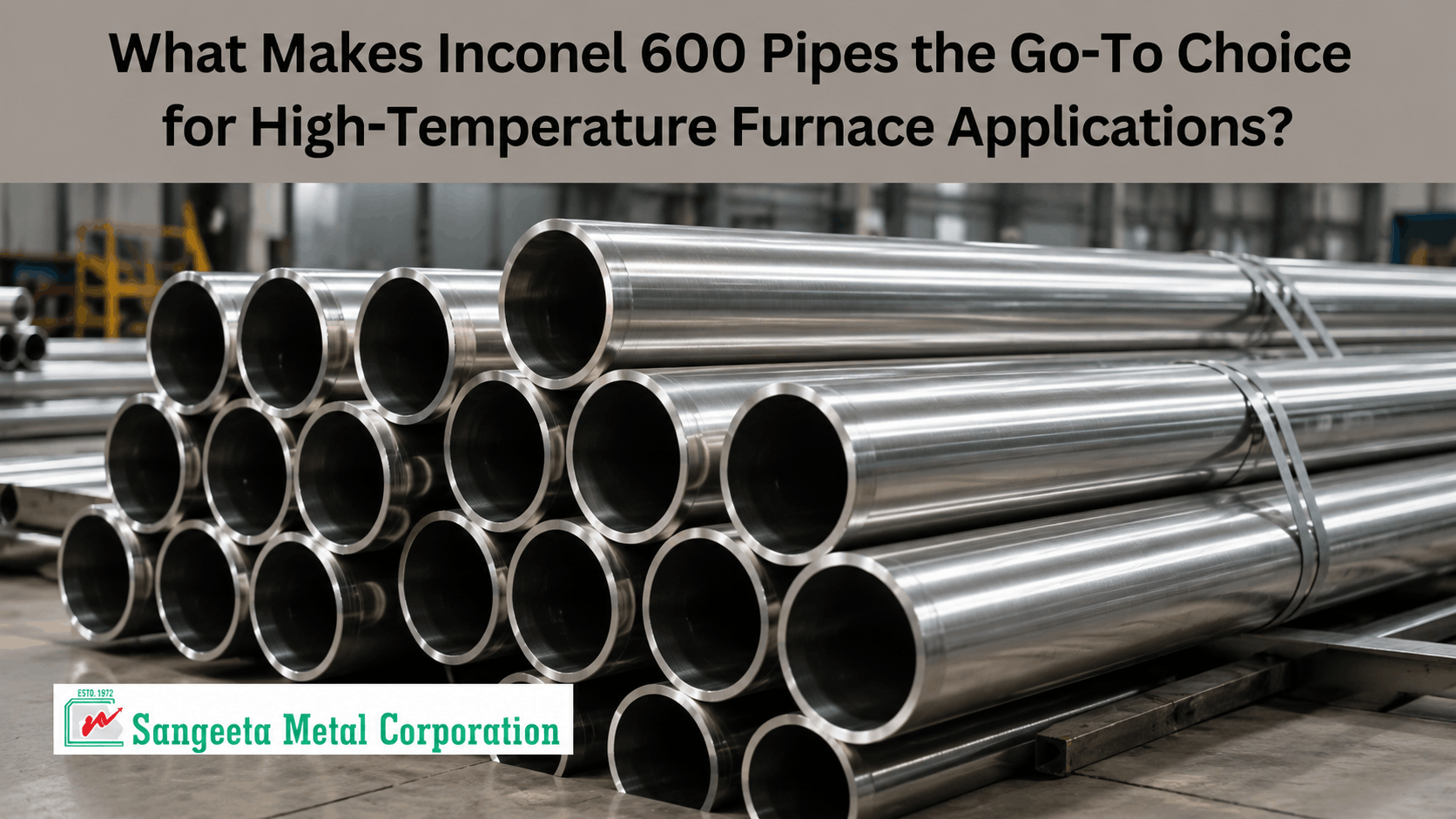
Inconel 600 pipes come in two primary forms. Seamless variants, produced by hot extrusion or rotary piercing, carry no longitudinal weld seam, which removes the most common stress concentration point in pressure-bearing pipe runs. Inconel 600 tubing and seamless pipes fall under ASTM B167, while welded variants are covered by ASTM B516 and B517, giving engineers certified options for both structural runs and instrumentation-grade applications.
Key Properties That Make Inconel 600 Pipes Ideal for Furnace Applications
Exceptional Oxidation Resistance at Elevated Temperatures
Inconel 600 withstands continuous oxidizing service up to 1175°C. The chromium oxide layer that forms on the pipe surface acts as a diffusion barrier, slowing further oxidation to a rate that supports years of service where stainless steel fails in months. In cyclic furnace duty, this scale stays adherent rather than spalling off and contaminating the furnace load.
High Mechanical Strength and Structural Stability
At 870°C, Inconel 600 retains a tensile strength of approximately 414 MPa. For comparison, 304 stainless steel drops to roughly 207 MPa at that same temperature. That retained strength lets engineers work with thinner walls without compromising pressure integrity, reducing material weight across large furnace installations.
Resistance to Carburization and Corrosive Furnace Environments
High nickel content directly opposes carbon ingress. In case-hardening furnaces with carburizing atmospheres, Inconel 600 absorbs carbon at far lower rates than iron-base alloys. The alloy also handles sulfur-bearing combustion gases and halide-contaminated environments, covering the corrosive chemistries that most industrial furnaces generate.
Excellent Thermal Fatigue and Creep Resistance
Repeated heating and cooling cycles generate fatigue cracks in alloys with poor high-temperature ductility. Inconel 600 maintains ductility at operating temperature, absorbing cyclic strain without initiating cracks. Under a stress of 35 MPa at 870°C, the alloy reaches 1% creep in approximately 1,000 hours, a predictable rate that supports structured maintenance planning rather than reactive repairs.
Why Industries Prefer Inconel 600 Seamless Pipes in Heat-Treatment Systems
Weld seam fatigue accounts for a disproportionate share of unplanned pipe failures in furnace systems. Inconel 600 seamless pipes remove that failure mode entirely, distributing stress uniformly around the pipe circumference and extending pressure-cycle fatigue life compared to longitudinally welded alternatives.
Continuous high-temperature service demands that consistency. A leaking furnace pipe forces the system offline, and in batch heat treatment operations, that downtime means scrapped loads and delayed production schedules. Operators who shift from seam-welded 310 stainless to Inconel 600 seamless pipe regularly report maintenance intervals extending from 12 to 18 months out to 4 to 6 years under comparable furnace conditions.
Common Furnace and Thermal Processing Applications
Heat treatment furnaces represent the largest single area of Inconel 600 pipe use. Annealing, normalizing, hardening, and tempering operations all require consistent gas distribution at temperatures where lesser alloys degrade within a single operating season.
Beyond heat treatment, petrochemical steam reforming furnaces and pyrolysis tubes operate above 900°C in hydrogen-rich and steam-saturated environments, and Inconel 600 handles both threats concurrently. Chemical processing plants rely on Inconel 600 tubing for chlorination and fluorination reactors, where halide attack at elevated temperatures destroys high-alloy stainless grades rapidly. Aerospace component manufacturing and power generation facilities also depend on the alloy for combustion test rigs and turbine heat treatment systems where dimensional stability under thermal cycling is non-negotiable.
Advantages of Using Inconel 600 Tubing Over Conventional Alloys
Longer Service Life
Measured against 310 stainless steel in identical furnace atmospheres at 1000°C, Inconel 600 tubing shows oxidation weight gain roughly 60 to 70% lower after 500 hours of exposure. Lower metal loss means wall thickness retention, which extends replacement intervals directly.
Improved Operational Safety
Predictable high-temperature degradation allows engineers to calculate remaining wall thickness from known oxidation rates. That replaces conservative preemptive replacements with risk-based scheduling, improving both safety margins and budget planning in critical furnace operations.
Better Performance in Aggressive Environments
Unlike alloys that resist only oxidizing or only reducing conditions, Inconel 600 performs across both. A furnace atmosphere that shifts as fuel-to-air ratios change does not destabilize its protective oxide layer the way it would disrupt a chromium-only protective system.
Cost Efficiency Through Reduced Failures
Fewer replacements reduce total material spend over a furnace’s lifespan. Initial pipe cost for Inconel 600 seamless runs higher than for 310 stainless, but when replacement frequency drops from annual to five-year intervals, lifecycle cost per year falls by 40 to 50% in typical continuous-operation schedules.
Factors to Consider When Selecting Inconel 600 Pipes
Furnace piping typically falls under ASTM B167 for seamless pipe and tube, ASTM B516 for welded tube, and ASTM B517 for welded pipe. ASME SB-167 covers pressure vessel and piping code applications. Match the material certification to the applicable code before procurement.
For pressure-bearing furnace runs above 700°C, seamless construction delivers better fatigue performance. Welded variants suit low-pressure gas distribution lines where thermal fatigue is a lower concern. Wall thickness selection must account for operating temperature since allowable stress decreases as temperature rises; at 1000°C, the ASME allowable stress for Inconel 600 sits at 11.7 ksi.
Supplier quality matters as much as alloy selection. Request mill test reports confirming chemical composition, mechanical properties, and ASTM certification. At Sangeeta Metal, we have been operating since 1972 with a focus on high-performance alloy products, maintaining full material traceability and manufacturing to ASTM/ASME specifications for code-governed pressure applications.
Conclusion
Inconel 600 pipes earn their place in high-temperature furnace applications through measurable metallurgical advantages: oxidation resistance to 1175°C, tensile strength above 400 MPa at operating temperature, carburization resistance, and creep behavior predictable enough to schedule maintenance around. Seamless construction extends those advantages by removing weld-related failure points from systems where unplanned downtime carries real cost. For engineers specifying furnace piping, the lifecycle performance calculation consistently favors Inconel 600.
Browse the full range of ASTM B167/B516/B517-compliant Inconel 600 pipes and tubes to find the right specification for your furnace application.