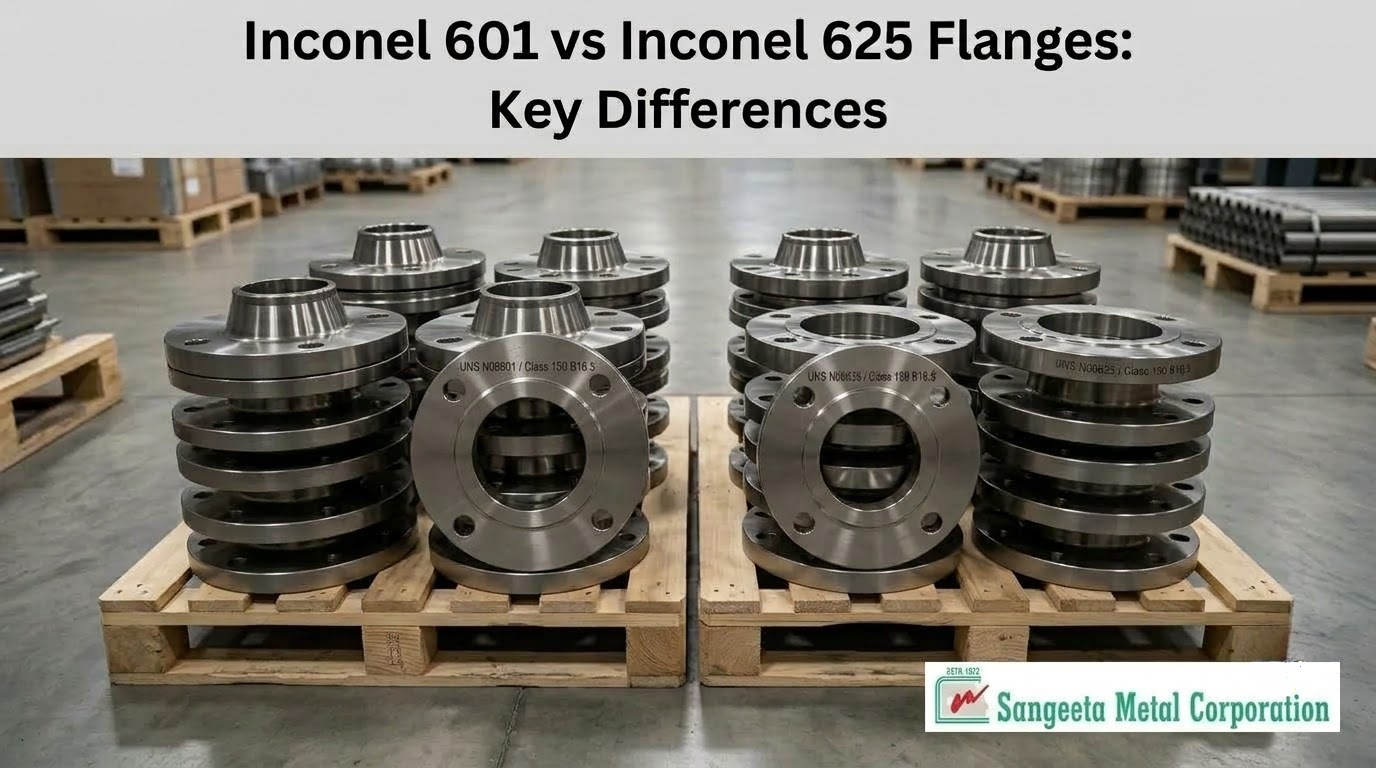
Choosing between Inconel 601 and Inconel 625 flanges comes down to one question: what is the flange actually facing in service? Both are nickel-based alloys built for demanding piping systems, but they solve different problems. Operating temperature, corrosion environment, mechanical loading, and the applicable specification all push the decision in different directions. ASTM B564 Inconel 601 Flanges tend to come up when the priority is holding up under sustained heat without scaling, while Inconel 625 gets pulled in for environments that are more chemically aggressive or mechanically demanding.
Inconel 601 vs Inconel 625 Flanges
The two alloys share a nickel-chromium base but diverge on what they’re optimized for. Inconel 601 (UNS N06601) leans on chromium and aluminium content for oxidation resistance at high temperatures. Inconel 625 (UNS N06625) adds molybdenum and niobium, shifting its strength toward corrosion resistance and mechanical performance across a wider range of conditions. Both are typically specified under ASTM B564 / ASME SB564, so the specification alone won’t tell you which fits the service conditions.
| Factor | Inconel 601 | Inconel 625 |
| UNS Designation | N06601 | N06625 |
| Primary Selection Focus | High-temperature oxidation resistance | Corrosion resistance and mechanical strength |
| Typical Service Consideration | High-temperature oxidizing environments | Severe corrosive and mechanically demanding environments |
| Forging Material Specification | ASTM B564 / ASME SB564* | ASTM B564 / ASME SB564* |
All technical details must be verified against applicable standards before publication.
Why Inconel 601 Flanges Are Selected
Engineers reach for Inconel 601 flanges when oxidation resistance at sustained high temperature is the deciding factor. The alloy’s chromium and aluminium content forms a stable oxide layer that holds up under repeated thermal cycling, a property that matters more than raw tensile strength in furnace and heat-treatment piping. Dimensional stability at elevated temperature is another weighted factor. For flange joints exposed to repeated heat-up and cool-down cycles, dimensional and mechanical stability must also be considered alongside oxidation resistance. Selection here isn’t about picking the “stronger” alloy; it’s about matching a specific failure mode, oxidation and scaling, to a material built to resist exactly that.
Where Inconel 601 Flanges Can Be Considered
High-temperature oxidizing environments are the common thread across which these flanges get specified. Furnace systems, heat-treatment lines, and thermal processing equipment put flanges through sustained exposure to hot, oxidizing atmospheric conditions where standard stainless flanges scale and lose section thickness over time. Piping tied to combustion equipment or exhaust handling sees similar demands, particularly where the flange sits close to the heat source rather than downstream of it. The consideration is the same each time: does the joint need to survive oxidation at temperature, or is the bigger threat chloride attack or mechanical stress? That question determines whether Inconel 601 is even in the running.
Specifications to Check Before Ordering
Before placing an order, confirm the material specification against ASTM B564 / ASME SB564 and the exact UNS N06601 designation on the mill certificate. Flange type matters just as much as alloy weld neck, slip-on, blind, and lap joint configurations behave differently under thermal cycling, so the type needs to match the piping design, not just the pressure class. Nominal size, pressure class, and facing (raised face, flat face, or ring type joint) should be locked down against the piping spec, along with bore and bolt-circle tolerances. Material certification and full traceability back to heat number are worth confirming in writing on projects with inspection requirements. Inconel 601 flanges are available across standard flange types and sizes, with certification provided against order requirements.
How to Choose Between Inconel 601 and 625 Flanges
A practical decision framework starts with operating temperature sustained high heat in an oxidizing atmosphere points toward 601, while moderate temperatures paired with aggressive chemical exposure point toward 625. The corrosive environment matters next: chloride-bearing streams, acidic media, or sour service generally favor the corrosion profile 625 offers. Mechanical loading and pressure requirements factor in too, since 625 typically carries higher strength across a broader temperature range. Flange dimensions, applicable standards, and inspection or documentation requirements round out the checklist. Inconel 625 isn’t automatically the “better” material it suits a different set of operating conditions, and the right answer depends entirely on what the piping system will see in service.
Conclusion
Matching flange material to actual operating conditions, not a general reputation for toughness, separates a flange that performs for years from one that fails early. Temperature profile, corrosion exposure, mechanical load, and the governing specification need to point in the same direction before a material is finalized. Where oxidation resistance at high temperature is the primary concern, Inconel 601 flanges manufactured to ASTM B564 / ASME SB564 are worth evaluating against the full set of service conditions before an order is placed.