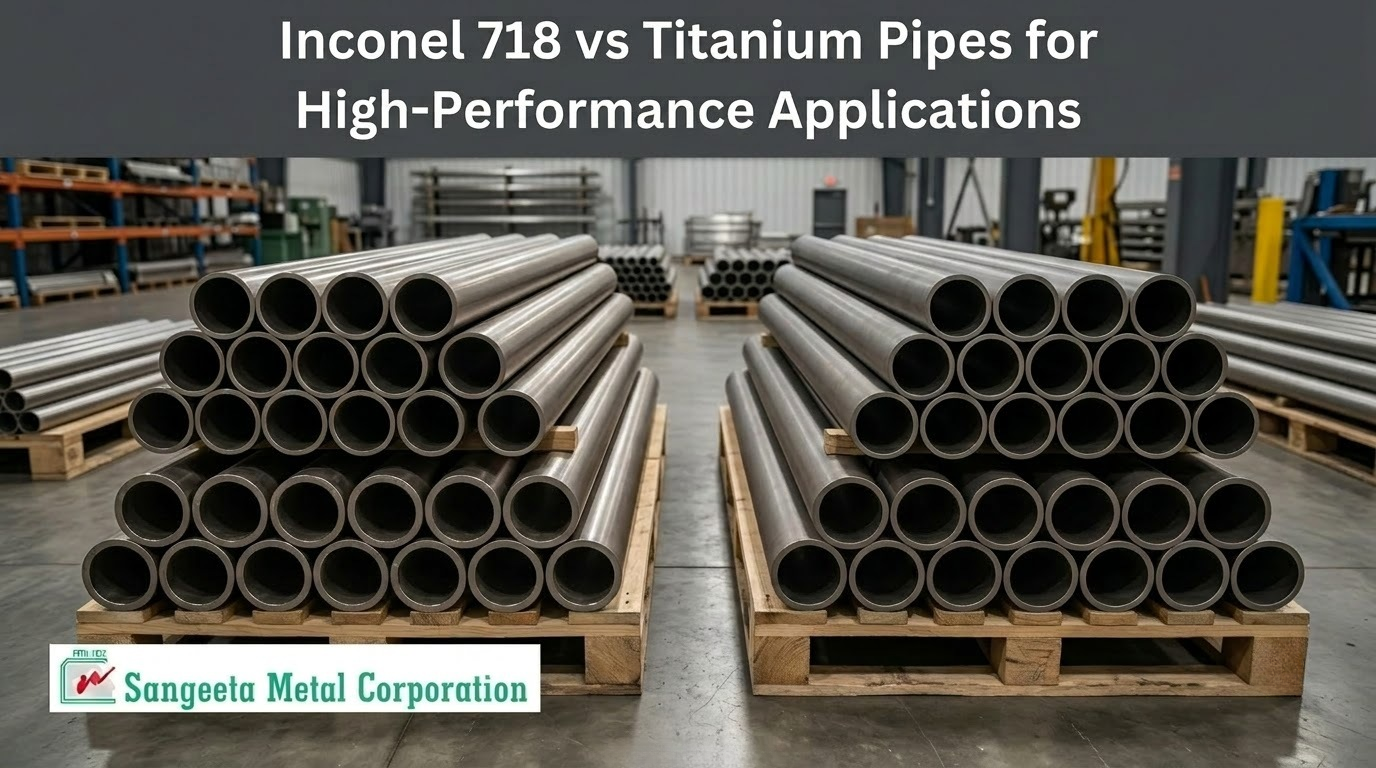
Selecting piping involves temperature, mechanical strength, corrosion resistance, working pressure and weight. Inconel 718 pipes and titanium Grade 5 pipes represent two engineering paths through that exchange. Inconel 718 is a nickel-based alloy built for demanding high-temperature and high-strength service. Titanium Grade 5 is characterized by its low density and high strength-to-weight ratio.
Inconel 718 vs Titanium Grade 5: What Sets Them Apart?
The two materials come from entirely different metallurgical families. Inconel 718 is a precipitation-hardenable nickel-based alloy, strengthened through controlled heat treatment that locks its microstructure into a high-strength state. Titanium Grade 5, known by its metallurgical designation Ti-6Al-4V, gets its performance from an alpha-beta phase structure. That structural difference drives everything downstream: Inconel 718 holds mechanical properties at temperatures and loads where titanium starts to deteriorate, while the titanium alloy delivers more strength per unit of weight.
Inconel 718 Pipes vs Titanium Pipes: Key Differences
A side-by-side view clarifies where each pipe material earns its advantage in specification work:
| Selection Factor | Inconel 718 Pipes | Titanium Grade 5 Pipes |
| Material family | Nickel-based alloy | Titanium alloy |
| Weight | Higher density | Lower density |
| Strength focus | High absolute strength | High strength-to-weight ratio |
| Elevated-temperature service | Strong candidate | More temperature-sensitive |
| Corrosion resistance | Strong resistance in many demanding environments | Strong corrosion resistance |
| Weight-sensitive applications | Less advantageous | Major advantage |
| Main selection driver | Temperature + strength + environment | Weight + strength-to-weight efficiency + environment |
Weight and temperature service drive most of the divide between the two pipe materials. Inconel 718 pipe carries a density near 8.2 g/cm³, approximately double that of titanium Grade 5 at 4.43 g/cm3 and the nickel alloy holds its strength up to about 704°C (1300°F). Titanium Grade 5 pipe stays in service up to about 400°C (750°F) before its strength margin narrows. Both alloys resist a broad range of corrosive media, but the mechanism differs: Inconel 718 relies on chromium and molybdenum content, while titanium forms a self-healing oxide layer that performs well in chloride-rich and marine environments. That oxide layer is also why titanium pipe sees wide use in seawater and offshore service. For piping systems where every kilogram matters, titanium’s lower density becomes the deciding factor. Where thermal load and absolute strength determine the design envelope, Inconel 718 pipe remains the stronger candidate.
When Are Inconel 718 Pipes the Better Choice?
Elevated operating temperatures push most piping decisions toward Inconel 718. The alloy retains tensile and yield strength well past the point where common engineering metals begin to soften, directly affecting systems carrying high mechanical loads at sustained heat. Thermal cycling compounds this advantage: Inconel 718’s stable microstructure resists the fatigue that repeated heating and cooling cycles create in less stable alloys. Corrosive service environments, particularly those involving sulfur compounds or high-temperature oxidation, add another factor favoring the nickel alloy. When absolute strength and thermal stability outweigh the priority of cutting a pipe weight, Inconel 718 pipes are the stronger engineering fit.
When Can Titanium Pipes Be the Better Choice?
Weight reduction changes the calculation entirely. Aerospace piping systems operate under strict mass budgets and titanium Grade 5’s strength-to-weight ratio lets designers meet pressure and strength requirements without the mass penalty a nickel alloy would add. The same logic applies to any weight-sensitive piping network, from offshore platforms to mobile processing skids, where lower structural weight eases handling, supports and overall system loading. Titanium Grade 5 also performs well in seawater and chloride-heavy environments due to its stable oxide layer. In these conditions, particularly where temperature stays within the alloy’s working range, titanium Grade 5 pipe offers a real design advantage over heavier alternatives.
How Should Engineers Choose Between Inconel 718 and Titanium Pipes?
Material selection starts with the operating envelope, not the alloy name. Engineers map operating temperature, working pressure and mechanical loading against the system’s weight limitations, then check the service medium and corrosion environment against each alloy’s resistance profile. Thermal cycling frequency, pipe or tube dimensions and seamless versus welded construction narrow the field further. The applicable material specification (ASTM B983 for seamless Inconel 718 pipe and tube) along with testing and certification requirements settles what gets ordered. Once these factors are considered, the decision becomes clearer. Inconel 718 suits applications where high-temperature strength and demanding service dominate. Titanium Grade 5 fits best where weight reduction and strength-to-weight efficiency matter most.
Why Consider Inconel 718 Pipes for High-Performance Service?
Inconel 718 pipes are widely used whenever a system demands high mechanical strength, stable performance at elevated temperature and resistance to corrosive conditions. Few piping materials hold all three properties together as consistently as this nickel-based alloy. Sangeeta Metal Corporation, a supplier and exporter of nickel alloys and stainless steel products since 1972, supplies Inconel 718 pipes and tubes in seamless and welded forms, built to meet applicable ASTM and ASME requirements. For engineers and procurement teams evaluating high-performance piping, an established Inconel 718 supplier simplifies sourcing, testing and documentation.