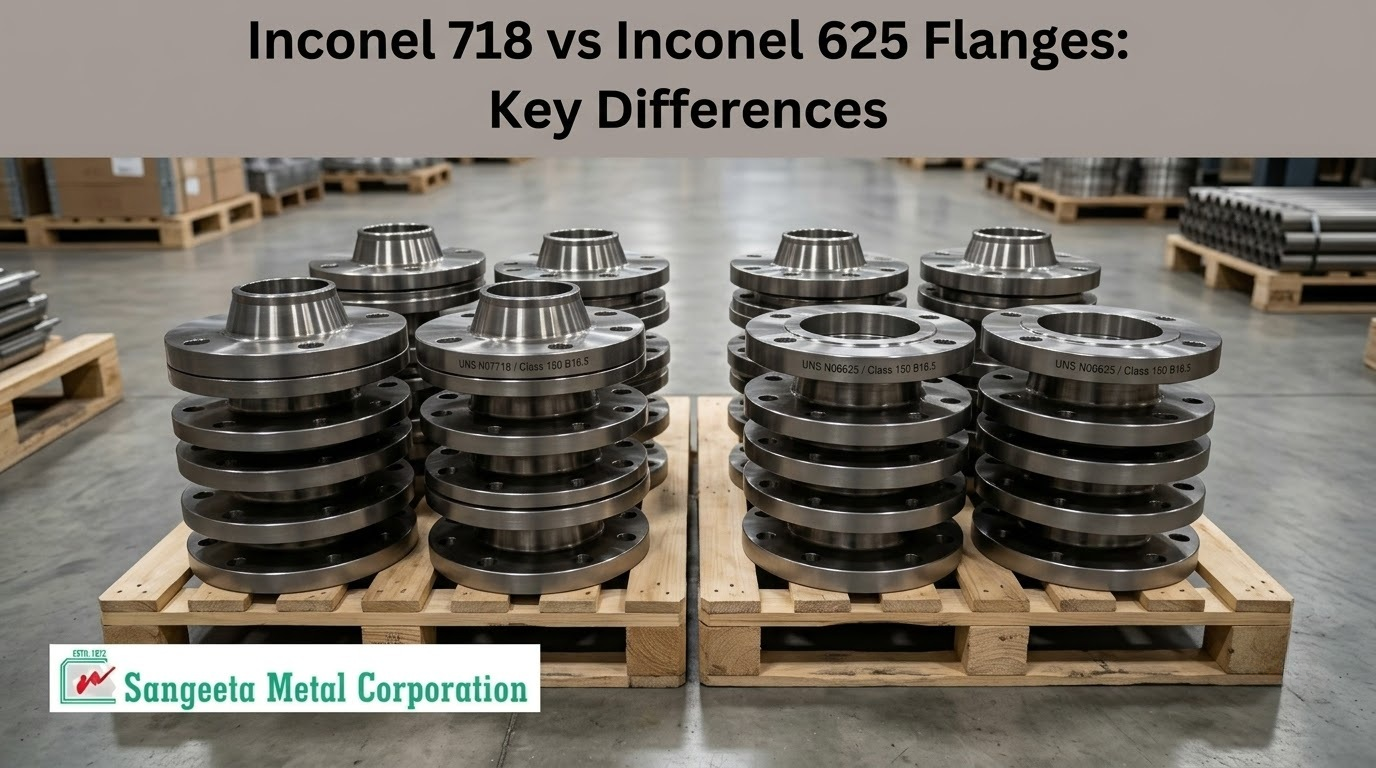
Choosing the right nickel alloy flanges for a demanding piping system often hinges on one key consideration: strength or corrosion resistance? That is the core of the Inconel 718 vs Inconel 625 comparison. Inconel 718, UNS N07718, is a precipitation-hardenable alloy built for load-bearing performance, and Inconel 718 flanges are specified where strength and elevated-temperature service determine the design. Inconel 625, UNS N06625, relies on solid-solution strengthening and is chosen for corrosion resistance and environmental durability.
Inconel 718 vs Inconel 625: What Makes Them Different?
UNS N07718 and UNS N06625 diverge at the metallurgical level, shaping how Inconel 718 flanges and Inconel 625 flanges perform in service. Inconel 718 gains its strength through precipitation hardening: a controlled aging step precipitates fine intermetallic phases through the nickel-chromium-iron matrix, raising yield and tensile strength above what solid-solution alloys reach on their own. Molybdenum and niobium dissolve directly into the matrix, producing a solid-solution-strengthened alloy prized for corrosion resistance over peak mechanical strength. The result: 718 favors strength, 625 favors resistance.
Inconel 718 vs Inconel 625 Flanges: Key Differences
| Selection Factor | Inconel 718 Flanges | Inconel 625 Flanges |
| UNS designation | N07718 | N06625 |
| Strengthening | Precipitation hardened | Solid-solution strengthened |
| Main advantage | High mechanical strength | Corrosion resistance and fabricability |
| High-temperature service | Strong candidate | Strong performance with different selection priorities |
| Corrosion resistance | Good in demanding environments | Excellent in many aggressive environments |
| Main selection driver | Mechanical loading and strength | Corrosion environment and fabrication |
These differences carry real weight once they reach an actual flanged connection. A flange under sustained mechanical load, especially one that also sees elevated service temperature, draws on the load-bearing strength that precipitation hardening gives Inconel 718. A flange exposed to acidic process fluid, chloride-bearing streams, or seawater tends to hold up better as Inconel 625, both because of its corrosion resistance and because it welds and forms without the aging response that Inconel 718 requires. Inconel 625 accepts welding with fewer downstream heat-treatment constraints, while Inconel 718 flanges need the alloy in a specific heat-treated condition to reach their design strength.
When Should Inconel 718 Flanges Be Selected?
Inconel 718 flanges suit connections where mechanical loading drives the design decision. High-pressure piping systems place continuous stress on the flange body and bolt circle, and the precipitation-hardened microstructure of UNS N07718 holds yield strength under that load more effectively than a solid-solution alloy of comparable composition. Elevated-temperature service adds another factor. Where a flange operates at sustained high temperature alongside meaningful mechanical stress, the aging response built into Inconel 718 keeps strength from falling off the way it can in some other nickel alloys. This makes Inconel 718 flanges a strong candidate for high-pressure, high-temperature connections carrying substantial mechanical load, though not every elevated-temperature flange calls for this alloy by default.
When Should Inconel 625 Flanges Be Selected?
Inconel 625 flanges fit applications where the surrounding environment, not mechanical load, poses the greater risk to the connection. Chemical processing lines carrying acidic or oxidizing media benefit from the corrosion resistance UNS N06625 offers across a broad range of process chemistries. Marine and seawater service is another common factor, since chloride exposure degrades many stainless and nickel alloys faster than it degrades this particular alloy. Piping systems handling corrosive process streams, whether on an offshore platform or inside an onshore chemical plant, often specify Inconel 625 flanges for that reason. The alloy also welds without the aging step Inconel 718 requires, which reduces certain manufacturing sequences.
How to Choose Between Inconel 718 and Inconel 625 Flanges
Choosing between the two alloys starts with the operating envelope. Engineers should evaluate operating pressure and temperature along with the mechanical loading the flange will carry, then layer in the corrosion environment and process medium, including any chloride or seawater exposure. Flange dimensions and pressure class affect how much margin the design carries, while material condition and heat treatment determine whether the alloy reaches its intended strength or corrosion performance. Fabrication and joining requirements, the applicable product specification, and inspection and certification requirements round out the review. Inconel 718 is the more appropriate choice when high mechanical strength is the primary requirement, while Inconel 625 becomes the more attractive option when corrosion resistance and environmental durability drive the decision.
Why Consider Inconel 718 Flanges?
Inconel 718 flanges remain a practical choice wherever a piping connection needs to combine mechanical strength with corrosion resistance and elevated-temperature capability. The precipitation-hardened condition gives the alloy load-bearing performance that solid-solution alloys cannot always match under the same conditions. Sangeeta Metal Works is an Inconel 718 exporter, supplying flanges to piping and process industries that need documented material condition and traceable certification alongside the mechanical properties the application requires.