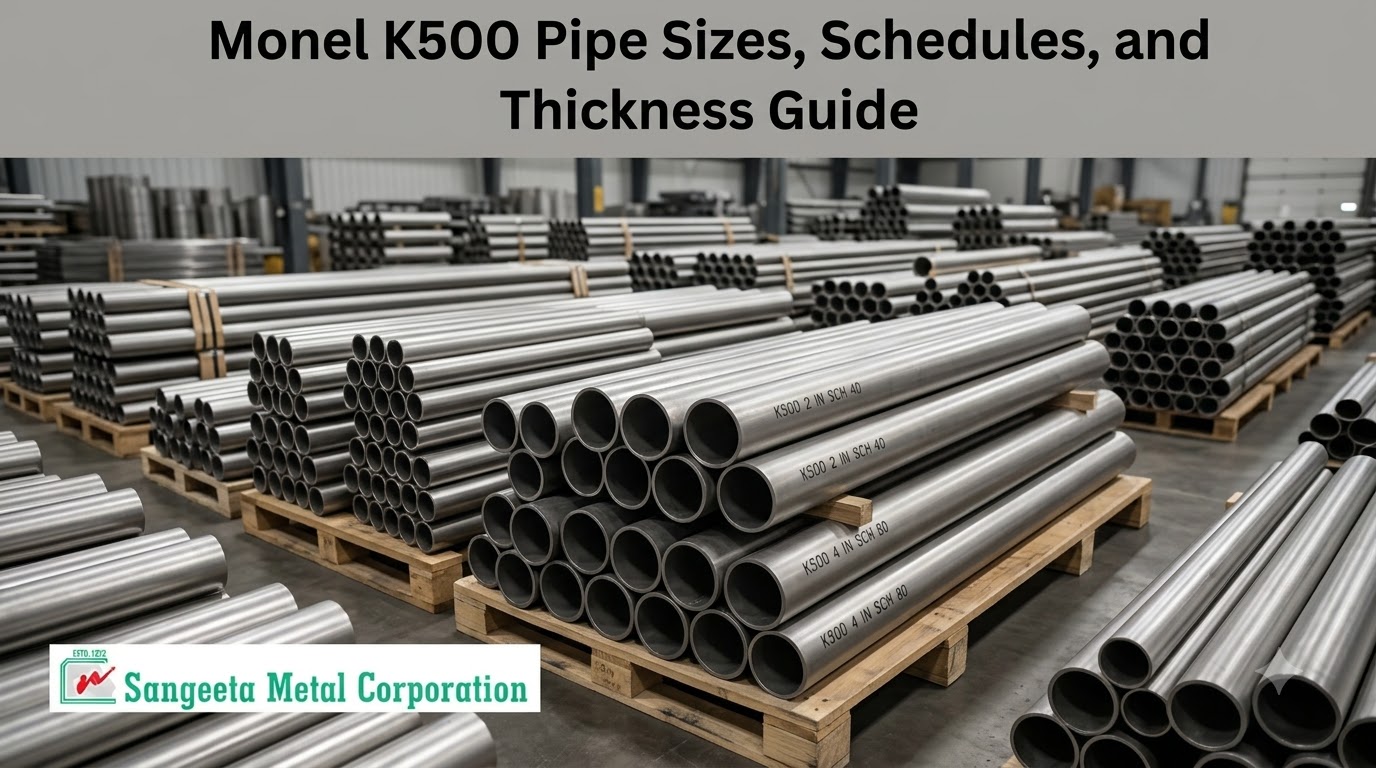
Choosing the correct pipe size, schedule, and wall thickness for Monel K500 Pipes requires the same careful consideration as selecting the alloy itself. Under sizing a pipe reduces pressure capacity and corrosion allowance before it even enters service, while oversizing increases welding time, freight weight, and material costs. Selecting the appropriate Monel K500 Pipes dimensions helps achieve the required mechanical performance, service life, and overall project cost efficiency.
Why Pipe Dimensions Matter More Than Alloy Grade Alone
Operating pressure dictates the initial dimensional calculations and is always checked against the pipe’s allowable stress. However, engineers must also account for corrosion allowance (sized for the expected service lifespan), flow velocity (to prevent erosion at elbows and reducers), and mechanical loading from supports or vibration. Alloy grade and pipe dimensions must be evaluated together in a single design pass.
Understanding the Monel K500 Specification Before Selecting Pipe Dimensions
UNS N05500 is a nickel-copper alloy that is age-hardened with aluminium and titanium to provide greater strength. The specifications are entirely dependent on the product form:
- ASTM B165 / ASME SB165: Covers dimensional tolerances, mechanical minimums and required heat treatments for seamless and welded Monel K500 pressure pipe.
- ASTM B163 / ASME SB163: Tubing for condensers and heat exchangers, tighter tolerance bands for tube bundles.
How Pipe Size Influences Flow Performance and System Design
The diameter choice affects far more than the dimensions of draft. There are four main reasons why engineers change the nominal pipe sizes:
Flow Capacity: Larger outside diameter increases flow area. Doubling the bore quadruples the flow capacity at a given velocity, greatly reducing pressure loss over long runs.
Pressure Drop: If the piping is undersized, fluid velocity must increase, which increases pump and compressor loads, energy consumption and erosion potential.
- Installation Space: Corridor widths on offshore platforms and refineries are fixed early; accurate sizing avoids costly mid-project rework.
- Future Expansion: By specifying a single nominal pipe size larger than the current requirements, the process can be immediately expanded, eliminating the capital expense and downtime of future line replacements.
Choosing the Right Pipe Schedule
Schedule selection follows the pressure and corrosion profiles established during design.
- Schedule 10 saves cost when extra thickness is not required. Schedule 40 is also reliable for everyday process piping.
- Schedule 80 & 160: Designed for harsh environments. Schedule 80 provides for higher pressures and mechanical wear.
| NPS | OD (in.) | OD (mm) |
|---|---|---|
| 1/2″ | 0.840 | 21.34 |
| 3/4″ | 1.050 | 26.67 |
| 1″ | 1.315 | 33.40 |
| 1-1/4″ | 1.660 | 42.16 |
| 1-1/2″ | 1.900 | 48.26 |
| 2″ | 2.375 | 60.33 |
| 2-1/2″ | 2.875 | 73.03 |
| 3″ | 3.500 | 88.90 |
| 4″ | 4.500 | 114.30 |
| 6″ | 6.625 | 168.28 |
| 8″ | 8.625 | 219.08 |
| 10″ | 10.750 | 273.05 |
| 12″ | 12.750 | 323.85 |
Wall Thickness by Schedule
| NPS | Schedule | WT (in.) | WT (mm) |
| 1/2″ | 10/10S | 0.083 | 2.11 |
| 1/2″ | 40/40S | 0.109 | 2.77 |
| 1/2″ | 80/80S | 0.147 | 3.73 |
| 3/4″ | 10/10S | 0.083 | 2.11 |
| 3/4″ | 40/40S | 0.113 | 2.87 |
| 3/4″ | 80/80S | 0.154 | 3.91 |
Wall Thickness Selection: Finding the Balance Between Strength and Cost
Internal pressure determines the minimum wall thickness, but external loads from soil weight, seismic movement or support spacing often dictate higher requirements. Thicker walls also change welding preheat practices and add significant weight, a critical metric for load calculations on offshore platforms. Specifying a needlessly heavy schedule raises material costs and fabrication time with no matching performance gain. Additionally, margins are governed by corrosion and mechanical wear depending on abrasive exposure and expected lifespan. Specifying a needlessly heavy schedule raises material costs and fabrication time with no matching performance gain.
Monel Pipe Specification Checklist Before Procurement
Before procurement, confirm these critical details with your exporter:
- Verify mill compliance with the exact ASTM or ASME edition on your purchase order.
- Confirm seamless or welded construction.
- Check outside diameter and wall thickness against standard tolerances.
- Match the schedule and length to the project’s isometric drawings.
- Request the heat treatment record to ensure proper precipitation hardening.
- Ensure traceability through a Mill Test Certificate (MTC), PMI testing, and third-party inspection (which also applies to mating Monel K500 Flanges).
Does the Monel K500 Casting Grade Influence Pipe Selection?
No, the Monel K500 casting material is designed for complex components such as valve bodies, pump casings or impellers. Pressure piping is delivered almost exclusively in wrought form (rolled or extruded) to ASTM B165 or B163 standards, which provide tighter tolerances and consistent mechanical properties for a reliable piping system.
Common Sizing Mistakes That Can Reduce Pipe Service Life
- Choosing a schedule based purely on upfront cost, which often leads to premature wall loss.
- Ignoring corrosion allowance, causing the pipe to meet pressure requirements on day one but fail before its intended lifespan ends.
- Overlooking future pressure requirements, forcing an expensive repipe once a process is debottlenecked.
- Oversizing without a documented reason wastes the project budget.
- Skipping specification verification, allowing costly dimensional errors to reach the site.
Conclusion
Proper selection of Monel K500 pipe requires the alloy grade, specification, nominal pipe size, schedule, and wall thickness to be considered as one decision. Getting the dimensions right helps protect pressure performance, service life, and project budgets. Before ordering, carefully review the available sizes and specifications with Sangeeta Metal Corporation to ensure the selected pipe meets the project’s requirements.